Between the 1400s and the 1500s, Italy was at the centre of a violent struggle for power between two powerful monarchies, France and Spain. The politically fragile peninsula was very desirable and the Kingdom of Naples found itself at the heart of a war which would give rise to a bloody battle.
In 1503 the Spanish captured 13 French Knights. Given their prestige, the knights were treated with great respect and a banquet was arranged in their honour. During the banquet, the Spanish continued to praise the military virtues of the Italians under their command, which the French could not tolerate. Their honour offended, they challenged the Italian soldiers to an equal duel, 13 against 13. This famous battle is known as the “Disfida di Barletta” (the duel of Barletta) and concluded in victory for the Italians.
One of the judges of this famous challenge was Francesco Zurlo, member of a noble family from Giovinazzo with Neapolitan roots. The Zurlo family were famous captains of fortune and boasted a long military tradition. Francesco is mentioned by the poet Bisanzio Lupis in sonnet 95 of his Canzoniere for his valour in the battle of Cerignola in which he lost an eye fighting against the French. Another member of the family, Captain Francesco Zurlo distinguished himself during the defence of Otranto against the Turks in 1480. The cathedral of Giovinazzo conserves the tombstone of the knight Enrico Zurlo, depicted in his armour.
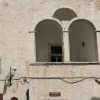
This building was the family’s residence and was modified over the course of the centuries but completed in Renaissance times with the addition of a double-arched loggia. The family crest is still visible on the doorway of an adjacent building, built in the 1800s. Near the palace, we can find Vico delle Cerimonie, an alleyway which is just fifty centimetres wide. Due to its dimensions, people were obliged to “fare le cerimonie”, giving way to each other in a ritual of courtesy which gave its name to the alleyway.